Best in the biz: The very best of Bill Flick


Meller's Chameleon
Common Name: Meller's Chameleon Scientific Name: Trioceros melleri Average Life Span In The Wild: 12 years Size relative to a teacup: IUCN Red List Status:? Least concernLeast Concern Extinct
Current Population Trend: UnknownThe Meller's chameleon is the largest of the chameleons not native to Madagascar. Their stout bodies can grow to be up to two feet long and weigh more than a pound.
Unique "Horn"Meller's distinguish themselves from their universally bizarre-looking cousins with a single small horn protruding from the front of their snouts. This and their size earn them the common name "giant one-horned chameleon."
Population RangeThey are fairly common in the savanna of East Africa, including Malawi, northern Mozambique, and Tanzania. Almost one-half of the world's chameleons live on the island of Madagascar.
Color ChangingAs with all chameleons, Meller's will change colors in response to stress and to communicate with other chameleons. Their normal appearance is deep green with yellow stripes and random black spots. Females are slightly smaller, but are otherwise indistinguishable from males.
DietThey subsist on insects and small birds, using their camouflage and a lightning-fast, catapulting tongue, which can be up to 20 inches long, to ambush prey.
In CaptivityExotic pet enthusiasts often attempt to keep Meller's chameleons as pets. However, they are highly susceptible to even the slightest level of stress and are very difficult to care for in captivity. In the wild, they can live as long as 12 years.
The Colorful Language Of Chameleons
This story appears in the September 2015 issue of National Geographic magazine.For sheer breadth of freakish anatomical features, the chameleon has few rivals. A tongue far longer than its body, shooting out to snatch insects in a fraction of a second. Telescopic-vision eyes that swivel independently in domed turrets. Feet with toes fused into mitten-like pincers. Horns sprouting from brow and snout. Knobbly nasal ornaments. A skin flap circling the neck like a lace ruff on an Elizabethan noble.
Of all its corporeal quirks, the chameleon is most defined by one, noted as far back as Aristotle: color-changing skin. It's a popular myth that chameleons take on the color of what they touch. Though some color changes do help them blend into their surroundings, the skin's changing hue is in fact a physiological reaction that's mostly for communication. It's the lizard using colorful language, expressing itself about things that affect it: courtship, competition, environmental stress.
At least that's the belief today. "Even though chameleons have attracted attention for centuries, there's still a lot of mystery surrounding them," says Christopher Anderson, a biology postdoctoral associate at Brown University and a chameleon expert. "We're still piecing together how their mechanisms actually work," from the explosive projection of the tongue to the physics of the varying skin colors. (Learn more about chameleons at a website Anderson runs.)
Scientists recently have made important discoveries about chameleon physiology by watching the lizards in captivity. Their future in the wild, meanwhile, is far from certain.
When the International Union for Conservation of Nature (IUCN) released a new Red List assessment of chameleons last November, it ranked at least half the species as threatened or near threatened. Anderson is a member of the IUCN Chameleon Specialist Group, as is biologist Krystal Tolley, a National Geographic grantee whose expeditions in southern Africa have documented new chameleon species and vanishing habitats. (Read Tolley's blog posts from her expeditions.)
In Afrikaans, says Tolley, chameleons have two common names. One isverkleurmannetjies, which means "colorful little men." The other, trapsuutjies, translates as "treading carefully." That refers to the lizards' odd, slow gait—but also could be read as a plea to conserve the curious species and their home terrain.
Even though chameleons have attracted attention for centuries, there's still a lot of mystery surrounding them.
Christopher Anderson, biology postdoctoral associate at Brown University
How Chameleons Change ColorAbout 40 percent of the 200-plus known chameleon species are found on the island of Madagascar. Most of the rest live on the African continent. Thanks to DNA testing, some chameleons that look nearly identical have been found to be genetically distinct. More than 20 percent of the known species have been identified in just the past 15 years.
Given their many odd traits, chameleons "have always intrigued naturalists," Anderson says. Because the lizards often died on the journey from Madagascar and the African continent to Western laboratories, early herpetologists could only guess at how live chameleons worked. That yielded theories that seem laughable now, he says: "It was once thought that the chameleon tongue projected because it inflated with air or filled with blood, like erectile tissue."
Anderson studies chameleon feeding in intricate detail. Using a camera that captures 3,000 frames a second, he turned 0.56 seconds of a chameleon eating a cricket into a 28-second instructional video on projection mechanics. (See videos of chameleon tongue projections.)
Stored in the lizard's throat pouch is a tongue bone surrounded by sheaths of elastic, collagenous tissue inside a tubular accelerator muscle. When the chameleon spies an insect, it protrudes its tongue from its mouth, and the muscle contracts, squeezing the sheaths, which shoot out as if spring-loaded. The tongue tip is shaped so that it acts like a wet suction cup, grabbing the prey. The tongue recoils; dinner is served.
Scientists have more to learn about tongue projection, Anderson says. His research suggests that in some chameleons, it may go even farther and faster than previously thought.
The understanding of chameleon coloration also has changed over time—and dramatically earlier this year, when Michel Milinkovitch's research was published. Scientists had long thought that chameleons changed color when skin cell pigments spread out along veinlike cell extensions. Milinkovitch, an evolutionary geneticist and biophysicist, says that theory didn't wash, because there are many green chameleons but no green pigments in their skin cells.
So Milinkovitch and his University of Geneva colleagues began "doing physics and biology together," he says. Beneath a layer of pigmentary skin cells, they found another layer of skin cells containing nanoscale crystals arranged in a triangular lattice.
By exposing samples of chameleon skin to pressure and chemicals, the researchers discovered that these crystals can be "tuned" to alter the spacing between them. That in turn affects the color of light that the lattice of crystals reflects. As the distance between the crystals increases, the reflected colors shift from blue to green to yellow to orange to red—a kaleidoscopic display that's common among some panther chameleons as they progress from relaxed to agitated or amorous. (See a video Milinkovitch's team made of a panther chameleon color change.)
New Ways to HideAt age seven, Nick Henn got his first chameleon. Twenty years later the hobbyist and breeder keeps as many as 200 of them in the basement of his business in Reading, Pennsylvania.
You May Also Like
ANIMALS
American crocodiles are spreading north in Florida. That's a good thing.ANIMALS
Can you spot these hidden animals?Rows of wire-mesh cages contain plants for climbing and sandy floors where females can lay eggs. Lights and misters simulate the lizards' native climes. Arranging the cages is as tricky as seating warring factions at a United Nations summit. To keep the animals from riling each other, Henn places females where they can't see males, and males where they can't see females—or rival males.
Ember, a young male panther chameleon, is a so-called red bar, a variety that's native to the Ambilobe district in northern Madagascar. His torso has red and green zebra stripes plus an aqua blue racing stripe along each side. When Henn opens Ember's cage and prods him to climb onto a long stick, he "gets grumpy," which Henn knows because the chameleon's red bars get a little brighter.
I keep envisioning the little chameleons clinging to their branches as that forest is getting chopped.
Krystal Tolley, biologist and National Geographic grantee
Henn carries Ember on the stick around a corner to the cage inhabited by Bolt, an adult male blue-bar panther chameleon and the largest lizard in Henn's collection. When Henn opens the door, and Bolt sees Ember, the response is immediate. By the time Bolt has advanced a few inches, his green bands have turned vivid yellow, and his eye sockets, throat, and spiked spine have changed from green to red orange. Ember becomes redder—but as shows go, Bolt's is far more flamboyant. For good measure, as Bolt crawls nearer, his mouth gapes wide, displaying bright yellow gums.
Henn retreats and puts Ember back in his cage. Had he not, he says, Bolt might have tried to ram or bite Ember, whose skin almost certainly would have changed to brown—the color of crying uncle. (A 2014 study concluded that chameleons developed this fade-to-drab submissive ability because their "slow-moving lifestyle severely restricts their ability to rapidly and safely flee from dominant individuals.")
Though all chameleons change color, some species don't change dramatically enough to cow observers. However, almost all chameleons do have another technique for physical intimidation: They can make themselves look larger. They narrow the width and increase the height of their bodies by unfolding their jointed, V-shaped ribs to elevate their spine. They also can look more massive by coiling their tails tightly and using their tongue apparatus to expand their throats. Turning this profile to its nemesis, the lizard looks significantly bulkier.
In the cages where Henn keeps female chameleons, one named Katy Perry—salmon pink because she's ready to mate—is next door to one named Peanut, pink with dark bars because she has already mated and is gravid, carrying eggs. If Katy were approached by a male that impressed her with his courtship colors and bobbing, swaying dance, she might submit to being mounted. If the same male approached Peanut, she would become intensely darker with bright spots and open her maw menacingly at him. If he persisted, she'd hiss or try to bite him.
Both male and female chameleons are polygamous. Most species are egg layers, but some deliver live young in clear, cocoon-like sacs. Chameleons do no parenting, so the young are on their own as soon as they're born or hatched.
To avoid the birds and snakes that hunt them, chameleons have evolved novel ways to hide. Most species are arboreal; when they narrow their bodies, they're slender enough to hide on the opposite side of a branch. If ground dwelling chameleons see a predator, Tolley says, some "play leaf," contorting their bodies to look like crumpled leaves on the forest floor.
Chameleons can hide from some threats but not from the slash-and-burn agriculture destroying their habitats. The IUCN lists nine species as critically endangered, 37 as endangered, 20 as vulnerable, and 35 as near threatened.
Identifying New SpeciesTolley and her team have identified 11 new chameleon species since 2006, in South Africa, Mozambique, Tanzania, and the Democratic Republic of the Congo. The Massachusetts-born professor has studied the lizards in Africa since 2001 and works for the South African National Biodiversity Institute in Cape Town.
When a genetics study confirms that a chameleon is a new species, "it feels like you're not just writing some random scientific paper that nobody will read," Tolley says. "You're accomplishing something—this is going to be forever."
In the next breath she notes that "at the same time as thinking, 'Wow, this is so cool,' it was awful. I keep envisioning the little chameleons clinging to their branches as that forest is getting chopped."
Describing it, her voice breaks. "I could not help thinking, I wish we'd never found them," she says. "Because if this doesn't stop, they'll soon be extinct."
How To Find The Chameleon In Little Kitty, Big City
One of the many fun challenges in Little Kitty, Big City, is the Find Chameleon challenge. This eight-part task is set by Chameleon and takes you all over the map. If you are having trouble finding your colorful friend then we are here to help. Read on to know how to find the Chameleon in Little Kitty, Big City.
Chameleon can't believe that his camouflage skills are not working on your sharp-eyed kitty and wants to test out different techniques. This is one of the longer challenges in Little Kitty, Big City and take you on a journey all around the map. Chameleon gives you poetic clues to help you discover every location but they can be a little cryptic! We have marked each of his locations in order on the map below followed by full details of how to get to him.
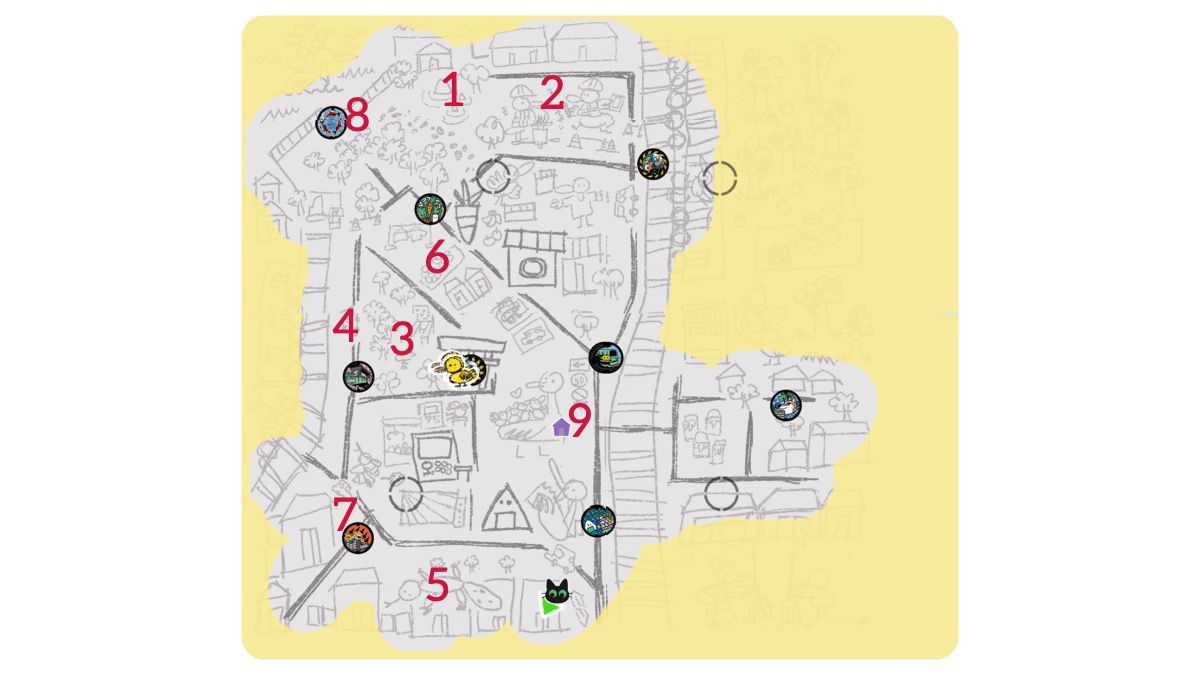 Image Source: Double Dagger Studio via Twinfinite Chameleon Location 1
 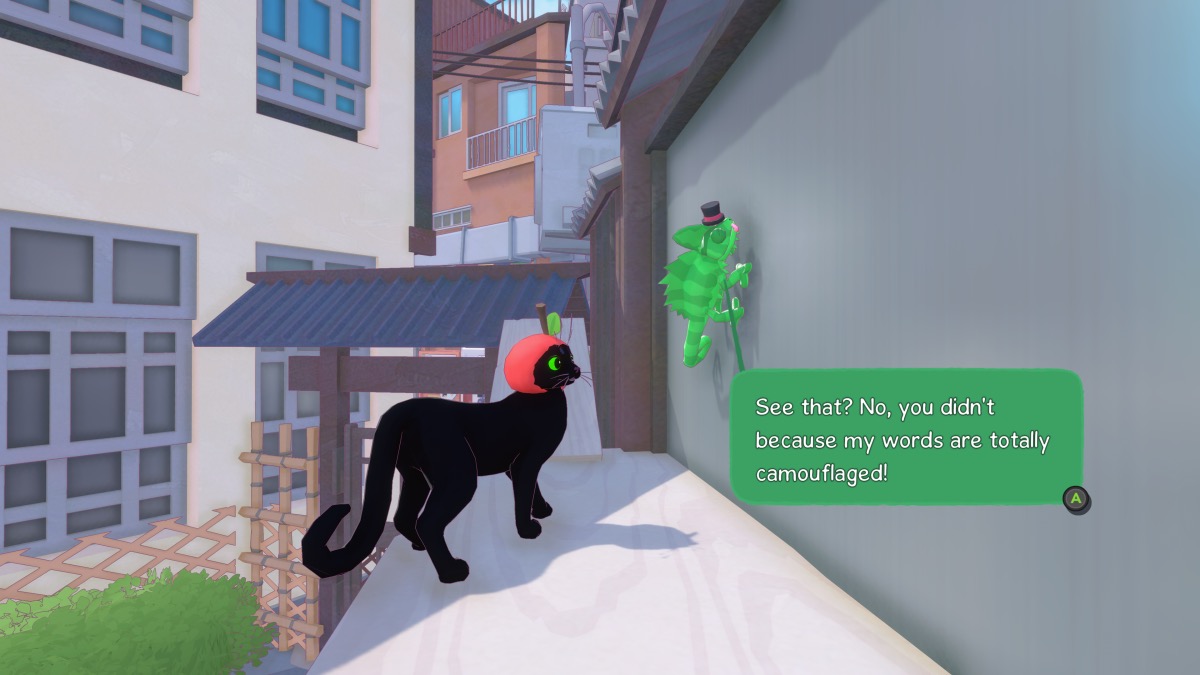 Image Source: Double Dagger Studio via Twinfinite
 You first meet your new friend at the large Zen Garden to the very north of the map. Chameleon is resting up on the wall in the sunshine. To get to him you will need to jump up on the crates and walk carefully along the wall, knocking off plant pots as you go. Chat with Chameleon and he will give you the challenge of finding him somewhere else in the city. He is nice enough to give you a clue to where he will be next:
There is a place where hard hats shine,
Where Concrete pours and diggers whine.
I'll be camouflaged nearby.
Invisible to your weird eye.
Chameleon has chosen to hide at the construction site next!
Cameleon Location 2 Image Source: Double Dagger Studio via Twinfinite
 Chameleon is hiding out somewhere near the construction site to the north of the map. This area is just around the corner from where you first meet him so just run around to the site and crawl through the gap under the fence. Go through the site and out of the gate, and then make your way to the portable toilet around the back. There is a dog nearby so you might need to distract him with a bone first. Chameleon is inside, trying to hide on the wall, and will give you the next clue:
A metal friend with arms spread wide,
Provides a place to climb and slide.
But you won't know I'm there at all,
Because I'll be invisible!
Chameleon is now hiding at the children's play park!
Chameleon Location 3 Image Source: Double Dagger Studio via Twinfinite
 Chameleon has made his way to the children's park towards the center of the map. He has found himself a sneaky spot up inside the slide and cannot believe you have discovered him again! It is easy enough to climb the slide so this is a pretty simple location to search. Yet again he tells you a poem to give a clue to his next location:
A sealed glass case containing snacks,
Can stop a human in their tracks.
What's better than just one machine?
A group of six to choose between.
It looks like the next location is a group of six vending machines, but can you remember where they are?
Chameleon Location 4 Image Source: Double Dagger Studio via Twinfinite
 The next location for Chameleon is right outside the park, so it doesn't take long to find him! Turn right out of the park to see six vending machines lining the street. Chameleon is perched right on top of the sixth machine. You can reach him leaping onto crates and then making your way along the vending machines. He gives you another poetic clue and sends you on your way once more.
Lizards used to rule the Earth,
And will again – just mark my words!
But, until then, there's World of Gecku,
A store where I will now expect you!
This is a huge clue and points you in the direction of a fun toy store to the south of the map.
Chameleon Location 5 Image Source: Double Dagger Studio via Twinfinite
 World of Gecku is a toy store located to the south of the map. Inside you will find another quest, this one involving a brave little yellow bird, and Chameleon hiding up on a high shelf. To get to him you will need to climb on shelves to your right as you enter the store. Work your way to the left on a shelf full of large Gecku toys to find Chameleon disguised in bright orange. Before you leave make sure you collect every Shiny you find on the shelves. Chameleon's poem will point you in the direction of your next location:
So far I've been too merciful,
So let's go somewhere way more vertical!
I'll be near a rooftop garden
Past the water-wielding warden!
If you have already explored the roof gardens you may know where Chameleon is disappearing to next!
Chameleon Location 6 Image Source: Double Dagger Studio via Twinfinite
 This roof garden is found near the area just before you get to the river. You can get to the rooftop garden by going past the kid's park and the six vending machines, and past a dog. Some crates and another vending machine can be seen on the building to the right. Climb those and clamber up the vines to get to the roof. Make your way up the boxes and along the planks to the next roof. Here you will find a woman watering her garden. Go around to the right and up over the chainlink fence to find Chameleon sat by the tap. If you haven't found the fish here you can turn the hose tap off and go around into the kitchen before you leave. Chameleon gives another clue to find him in another high-up place:
The rooftop was a bad idea
An alleyway will bring me cheer.
Just look out for the big red bullseye
And something, something, something… BYEEE!
Something tells me Chameleon is running out of ideas for his poems…
Chameleon Location 7 Image Source: Double Dagger Studio via Twinfinite
 This next location is in the southwest corner of the map. Chameleon is in the alley but is hiding up near the air ducts so you need to climb up and find him. Use the red truck outside the alley to clamber up along the ducts and over the fenced-off area in the alley. Jump up onto the air vents and along the pipes to find Chameleon sat on the wall nearby. It takes a couple of tries as these jumps are a bit awkward, but you should get there in the end! Chameleon gives you another clue to help you almost complete this challenge:
You'll come down to the riverfront,
Where, magic-cloaked, I'll watch you hunt.
To find me is your dearest wish…
Just don't get side-tracked by the fish!
So the next location is by the riverside… But how easy will it be to find Chameleon?
Chameleon Location 8 Image Source: Double Dagger Studio via Twinfinite
 This is a relatively easy one to complete, especially if you have been to the river to get your fish already. Chameleon is not right by the river but can be found up on a sign on the path nearby. He only has one more place to try, so follow his clue to discover the final hiding place:
Beside the small convenience store
Protected by a well locked door
You'll find a room where humans rest.
And that's where I'll conclude my test!
Chameleon has at last given his final clue! A room where humans rest… A restroom perhaps?
Chameleon Location 9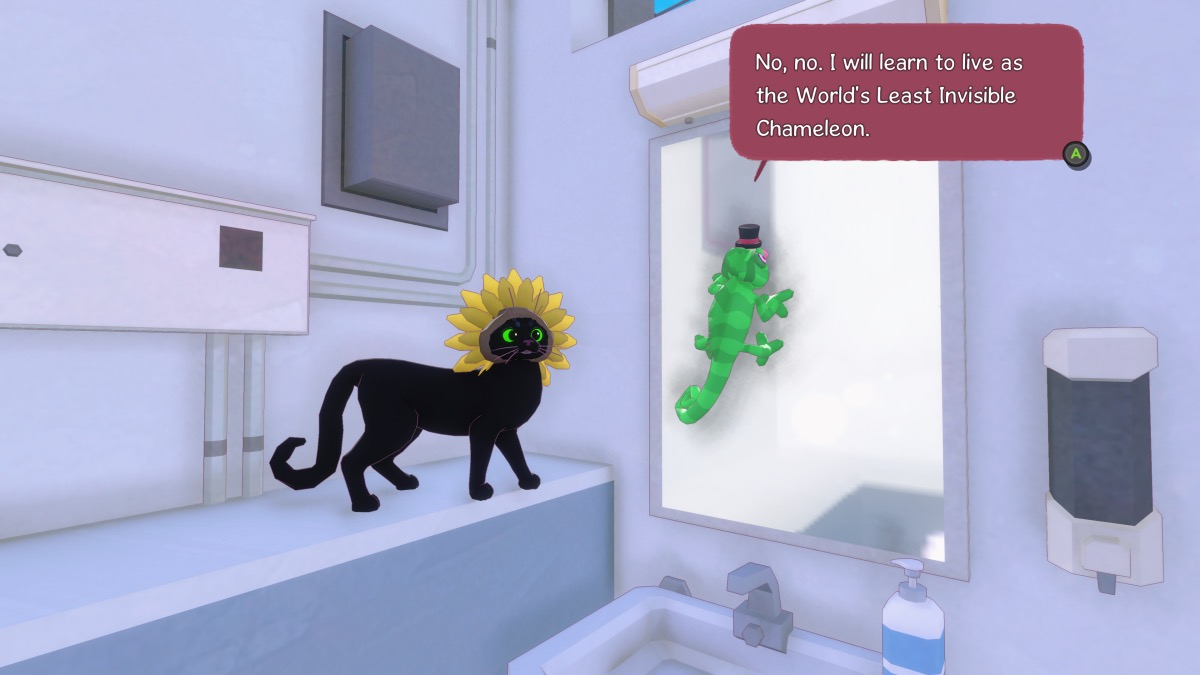 Image Source: Double Dagger Studio via Twinfinite
 The final location for Chameleon is inside the restroom to the east of the map, near where you started out. You can access this room through a window but first, you must find a bone and give it to the dog. Since the dog is distracted you can jump up on the boxes and get in through the window. Chameleon is on the mirror waiting for you! Your prize for completing this challenge is a stylish top hat.
Now you have found Chameleon, why not try and find every hat in Little Kitty, Big City? Or try the duckling challenge instead!
Twinfinite is supported by our audience. When you purchase through links on our site, we may earn a small affiliate commission. Learn more


Comments
Post a Comment