All In The Family: Maine Mother & Son Charged in Massive Drug Bust


Venomous Snake Found In School: 'We Rushed Over As Quickly As We Could'
A highly venomous snake has been removed from a schoolyard by a snake catcher.
Stuart McKenzie, owner of Sunshine Coast Snake Catchers 24/7, posted a video of the eastern brown snake and its rescue on Facebook.
The four-foot-long serpent can be seen in the video lurking by the side of a school building in Australia, with McKenzie approaching it slowly with a fabric bag in his hand.
"This beautiful Eastern Brown was making its way through the school yard when the teachers noticed it! We rushed over as quickly as we could to ensure the safety of the children and of the snake," McKenzie captioned the post.
Screencaps from the video of the eastern brown being rescued. Eastern brown snakes are among the most venomous in the world. Screencaps from the video of the eastern brown being rescued. Eastern brown snakes are among the most venomous in the world. Sunshine Coast Snake Catchers 24/7Native to Australia, Papua New Guinea, and parts of Indonesia, eastern browns are considered one of the world's most venomous snakes. Adults generally range between 4 and 6 feet in length, with some reaching over 7 feet long.
"It is a large species, growing to over 2 meters in length, and occupies a range of habitats, including rural and urban areas where it is attracted to rodents," Damian Michael, a landscape ecologist and herpetologist at Charles Sturt University, told Newsweek. "It has a naturally 'nervous' disposition, often flattening its neck or rearing up into an S-shape when it feels threatened."
Eastern browns have one of the most potent venoms in the world, containing neurotoxins and blood coagulants, and bites can be fatal without rapid medical treatment.
Deaths are thankfully relatively rare thanks to the availability of antivenom and improved medical response times. However, eastern browns are responsible for more deaths in Australia than any other snake species.
"Snakes are reluctant to bite humans unless they feel threatened, so if they are left alone and not killed, a bite is rare," Michael said.
In the video, McKenzie can be seen grabbing the snake by the end of its tail and holding it in the air at arms length.
"Nice size! It's about four foot, four and a half foot," he can be heard saying in the video. "Nice and warm, as you can imagine on a day like today."
McKenzie then placed the snake into the fabric bag, thanking the teacher for watching the snake to make sure it didn't get close to any children.
"You've done such a good job to keep an eye on it, thank you for that," he said. "Braver than most people!"
McKenzie then released the snake into the wilderness, with the video showing the serpent rapidly slithering into the bushes.
"It's incredible how quick they just vanish. You would never know it was there in that undergrowth," one commenter said under the video.
In the case of a snake bite, immediate pressure bandaging and immobilization of the affected limb is crucial while waiting for emergency medical help. Specific antivenoms are available and recovery is usually possible with prompt treatment.
Do you have a tip on a science story that Newsweek should be covering? Do you have a question about snakes? Let us know via science@newsweek.Com.
Discover The Largest Snake Found In Yellowstone National Park
Yellowstone National Park is one of the most famous parks in the United States, but it isn't usually known for its reptiles. Nevertheless, there are plenty of snakes that live in the park, with some of them being quite dangerous. Today, we will take a look at the largest snake found in Yellowstone National Park and learn a little about it. Additionally, we will learn about the largest venomous snake in the park. Let's get started!
The Largest Snake Found in Yellowstone National Park: Bullsnake (Pituophis catenifer sayi)Bullsnakes are a
gopher snake
subspecies but look similar to rattlesnakes.
©GoodFocused/Shutterstock.Com
The largest snake in Yellowstone National Park is the bullsnake. They are unique in that they look similar to rattlesnakes and even mimic them in some instances. Bullsnakes are a gopher snake subspecies, a group of snakes that can be found across most of the United States. Let's learn a bit about them.
Once a bullsnake bites its prey, it slowly squeezes it until it dies of asphyxiation.
A Complete Breakdown of the BullsnakeBullsnakes are the largest snakes that can be found in Yellowstone. Most individuals measure between 50-72 inches long, or nearly 6 feet. In addition to their length, bullsnakes are relatively large-bodied, around 3-4 inches in diameter at their thickest.
When it comes to appearance, people often confuse them with rattlesnakes, even though they aren't venomous. They generally have black, brown, or reddish-brown blotches down their backs, usually in a square shape. The squares are usually darker near the head and tail, and the snake's base color is yellow, making a striking pattern. These snakes have small heads and round pupils, and they flatten them when threatened. Bull snakes have vertical bars that extend from their lower lip through their upper lip called labial bars. Of course, not all nonvenomous species have these, but in the U.S., this is a clear sign that the snake you see is nonvenomous. Additionally, they will shake their tails in a defensive behavior to mimic a rattlesnake, although, like other colubrids, they don't have a true rattle.
Bullsnakes are generally found in the lower elevations of the park. They mostly prefer warmer areas with a dry climate, especially near open ground. An example of their prime habitat would be the Mammoth region within the park. They live in small burrows, which is also where they hunt prey, hence the name "gopher snakes."
Bullsnakes eat small mammals and subdue them using constriction, not venom. Once they bite prey, they slowly squeeze it until it dies of asphyxiation. They eat a variety of prey, including mice, moles, rats, gophers, squirrels, eggs, birds, and other reptiles and snakes.
The Largest Venomous Snake in Yellowstone National Park: Prairie Rattlesnake (Crotalus viridis)Prairie rattlesnakes, also called western rattlesnakes, are the only venomous snake in Yellowstone.
©iStock.Com/HRossD
Although the bullsnake is the largest reptile in Yellowstone, it isn't the most dangerous. The largest and most venomous snake within the park is the prairie rattlesnake. The prairie rattlesnake is a venomous pit viper related to other rattlesnakes, plus copperheads and cottonmouths. Using venom and heat-sensing pits on their snouts, pit vipers effectively hunt prey and defend themselves from predators.
A Complete Breakdown of the Prairie RattlesnakePrairie rattlesnakes are the second-largest snakes in Yellowstone and the largest (and only) venomous snakes in the park. They generally grow to 48 inches long and are extremely thick-bodied snakes.
Like all rattlesnakes, the prairie rattler can be identified through the heat-sensing pits between its nostril and eye, and the distinct rattle on its tail. Dorsally, prairie rattlesnakes have large, dark, roughly oval white-edged blotches over a lighter color; usually shades of tan or brown. Additionally, prairie rattlesnakes usually have light-colored head stripes — two on each side. Like other rattlesnakes, prairie rattlesnakes have heavily keeled scales that have a ridge in the center of each. Keeled scales make their skin look rough to the touch.
Prairie rattlesnakes live in the lower elevation areas of the park, namely in places like Reese Creek, Stephens Creek, and Rattlesnake Butte. They prefer warm, dry areas, and these locations are the warmest and driest locations in the park.
Prairie rattlesnakes use powerful venom to hunt prey and defend themselves. They generally prefer small mammals but will also eat birds and reptiles. Common prey includes squirrels, mice, rats, prairie dogs, rabbits, and other snakes.
Despite their powerful venom, rattlesnakes are much more defensive than offensive and prefer to avoid humans at all costs. In fact, the park has only two documented cases of bites throughout its entire history of the park. If you encounter a snake, just leave it be!
What Other Snakes Live in Yellowstone National Park?Rubber boas, which can grow to 28 inches long, can be found in Yellowstone National Park.
©yhelfman/Shutterstock.Com
Besides the two listed, there are a few other reptiles you could encounter in the park.
Rubber boas are cute burrowing snakes that are closely related to boa constrictors. These snakes are becoming more popular as pets due to their unique appearance and great temperaments. They generally grow to 28 inches long at a maximum and spend most of their day buried under the soil.
There are two species of garter snake that live within the park; the common garter snake and the terrestrial garter snake. Both species are harmless to humans and grow to be 2-3 feet long. They are extremely common across the country and are the most common snakes found in the park. Common garter snakes have black bodies with three yellow stripes running down their bodies, one along the spine and two on the sides. Additionally, they have red spots between the spine stripe and side stripes on either side. The terrestrial garter snake is a brown or tan color and has the same style of stripes, only in white or cream.
What Are the Venomous Snakes in Yellowstone National Park?Prairie rattlesnakes are the only dangerously venomous snakes in Yellowstone. Prairie snakes use powerful venom to hunt prey and defend themselves. They generally prefer small mammals but will also eat birds and reptiles. Common prey includes squirrels, mice, rats, prairie dogs, rabbits, and other snakes.
The post Discover the Largest Snake Found in Yellowstone National Park appeared first on A-Z Animals.
View comments
Snakes Of New York
New York state is home to 17 species of snakes. These animals, whose tubular, limbless bodies are instantly and universally recognized, produce mixed reactions among people, from fear to fascination. Serpents figure prominently in the mythologies of nearly all human cultures, sometimes as a symbol of evil and temptation. It is perhaps for this reason that snakes often are persecuted and killed without any understanding of their true nature.
Snakes play critical roles in the environments where they occur, primarily by the position they hold in food webs in natural communities. Many snakes are top level predators; for example, a single rat snake can consume over 100 rodents a year.
Other snakes are important in the control they exert on insect and other invertebrate populations. All snakes form part of the diet of other predators such as hawks and foxes and thereby serve to link higher and lower feeding levels.
Common Snakes of New YorkThe most widespread and frequently encountered snakes in New York state are the garter snake and the water snake. Garter snakes use a wide variety of habitats, from woodlands to marshes to fields and exist quite well around human habitations. These snakes, like many other species, are variable in color and pattern; the basic color is dark brown or green with three yellowish stripes down their sides and back. They may reach lengths of two feet, but are typically smaller. They are completely harmless to people.
The water snake is found in and around almost any waterbody or wetland in the state. As an adult, it is a stout animal typically dark brown to black with lighter-colored bands and splotches along its length. This is most pronounced in young individuals (adults may appear solid black). It is the only large (up to 42 inches) water snake in our range. This species is frequently called or mistaken for a cottonmouth (water moccasin); this latter species is a large venomous snake that does not occur within our state borders. This confusion is understandable as our water snake is certainly an aggressive species with a nasty disposition and it does bear a superficial resemblance to the cottonmouth.
The milk snake has given rise to more misconceptions than perhaps any other species. Its name is derived from the decidedly false belief that it will milk cows! It is, however, frequently encountered in barns in search of its rodent prey (it also eats other snakes). The milk snake is a boldly patterned serpent (brown or reddish blotches on a light grey to tan body) that vibrates its tail when annoyed. These characteristics are undoubtedly responsible for its being called "spotted adder" in some regions, an unfortunate name because it brings to mind the truly venomous snakes of Europe and Asia. The milk snake is harmless.
The largest species in New York is the black rat snake, reaching lengths of eight feet! These largely black-colored snakes are found primarily along cliffs and rocky slopes but are absent from most of the Adirondacks. It is an impressive animal that overpowers its bird and small mammal prey by constriction.
Other kinds that occur all across New York in appropriate habitat are the green, redbelly, brown, and ringneck snakes; all four of these are small, slender, and completely benign species that feed on insects, spiders, earthworms and slugs. Each is described quite well by their common names.
Venomous Snakes in New YorkDistribution and IdentificationThere are only three species of venomous snakes living in the wilds of New York (many other kinds may be found in the homes of private individuals and, occasionally, escapes occur!). These are the timber rattlesnake, the massasauga (erroneously called "pygmy rattler"), and the copperhead. All three are uncommon. The timber rattlesnake (listed as "Threatened" by the New York State Department of Environmental Conservation) enjoys the widest range; it is found mainly in the southeastern part of the state, except Long Island and New York City, with scattered populations as far north as Lake George and also along the Southern Tier in western New York. Its populations have been severely reduced, primarily due to bounties and commercial capture for snakeskin products and the pet trade. The massasauga (listed as "Endangered") occurs in only two locations, both large wetlands. One is located northeast of Syracuse and the other is west of Rochester. This species is the subject of a cooperative research program between researchers at SUNY-ESF and NYSDEC. The copperhead is mainly found along the lower Hudson Valley south of Kingston and scattered through the Catskills.
The timber rattler and massasauga both possess a rattle at the end of their tails. It is made of a series of hollow scales that produce a distinct buzz when the snake vibrates its tail (a new one is added each time the snake sheds its skin, which may be several times a year). Both rattlers are sort of chunky snakes but the timber rattlesnake can attain lengths of up to six feet while the massasauga barely reaches three feet. A timber rattler's head is much wider than a massasauga's and there are numerous small scales on the crown of its head; the massasauga has nine larger scales on the crown. Copperheads lack the rattle, but will vibrate their tail when annoyed. In dry leaves, this vibration can sound like a rattle; many other species, such as milk and rat snakes, will also perform this behavior. The copperhead can be told by its coppery-red head and by the distinct bands along its body which are widest at the sides and narrowest across the back.
Venomous snakes are best left alone. None of our species are particularly aggressive animals, but they will attempt to bite when handled.
Snake Species Within New YorkAll photos by John White (copyrighted). Used with permission from University of California CalPhotos collection
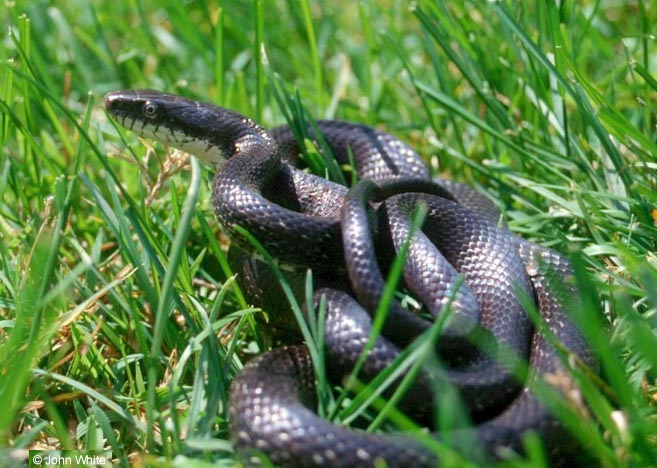
Black Rat Snake
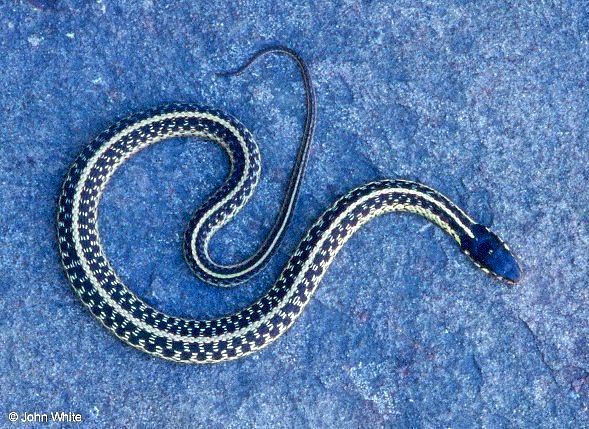
Eastern Garter Snake
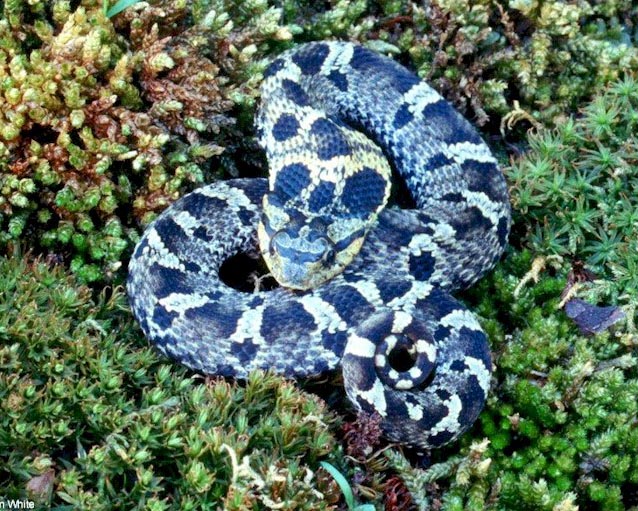
Eastern Hognose Snake
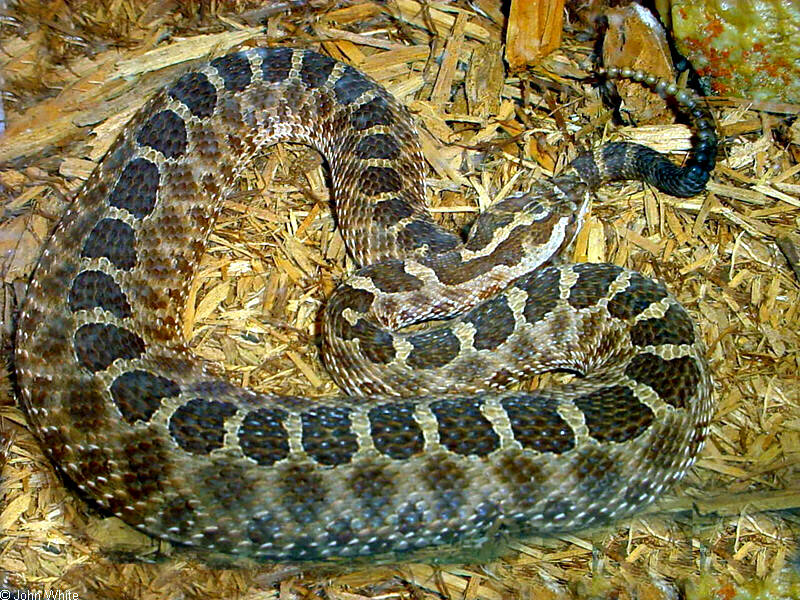
Eastern Massasauga
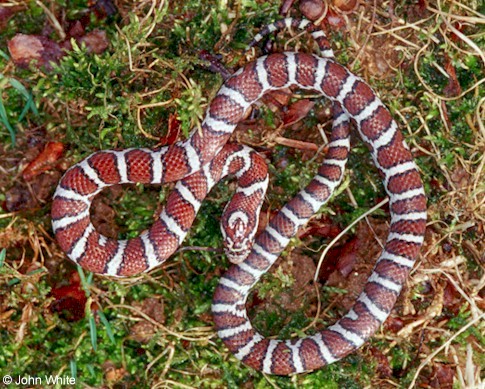
Eastern Milk Snake
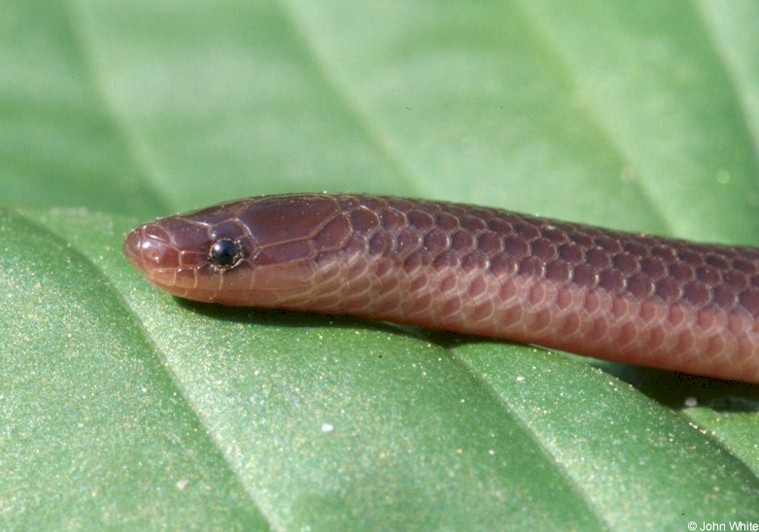
Eastern Worm Snake
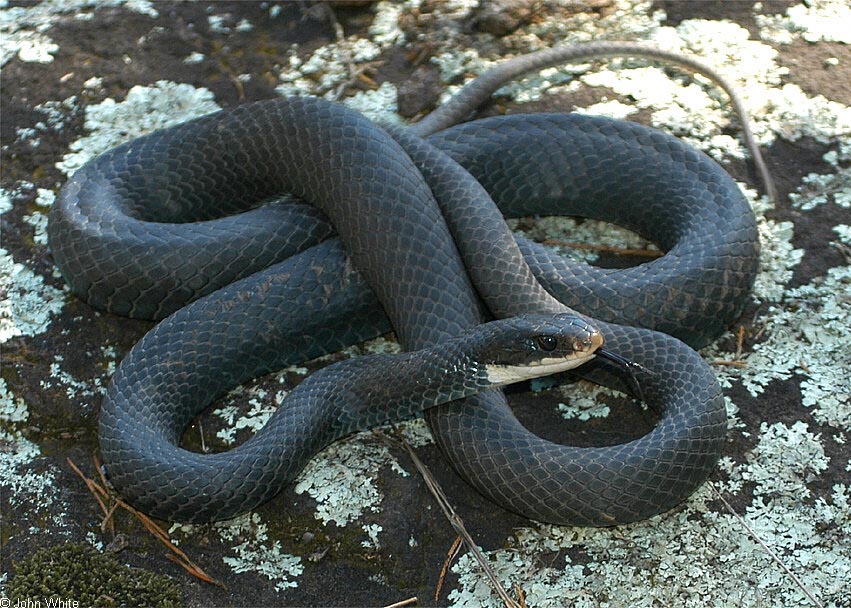
Northern Black Racer
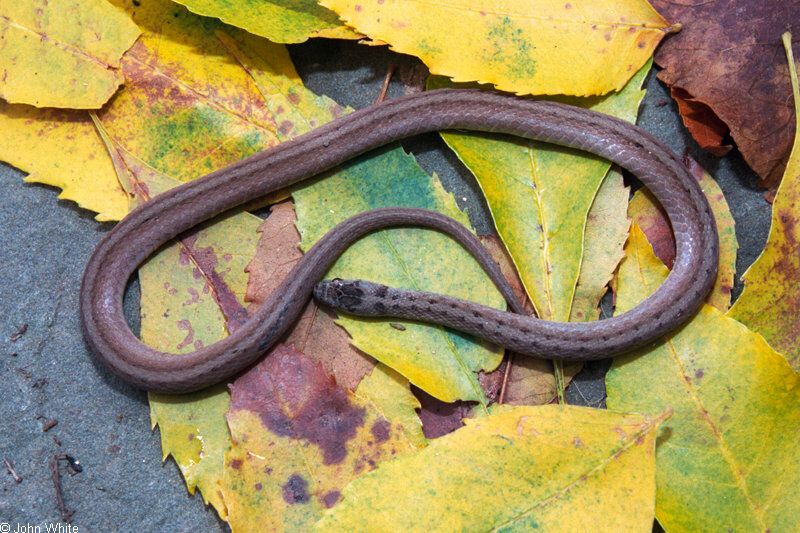
Northern Borwn Snake
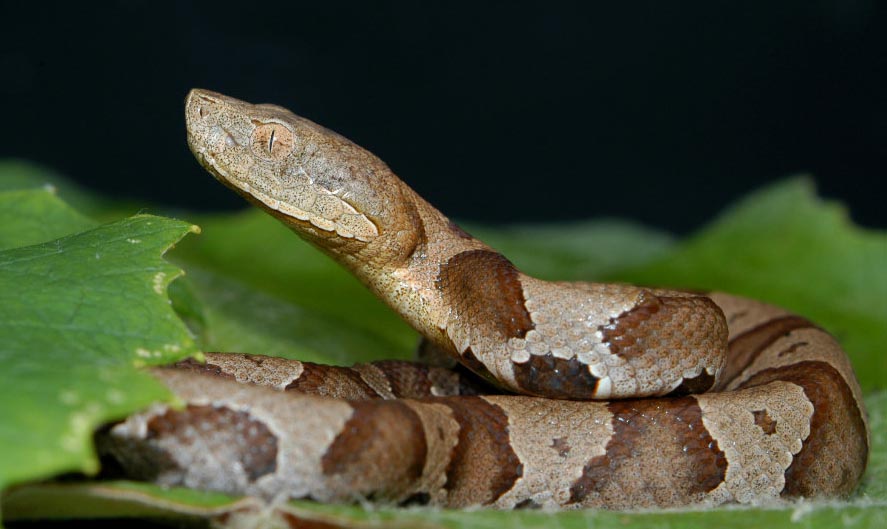
Northern Copperhead
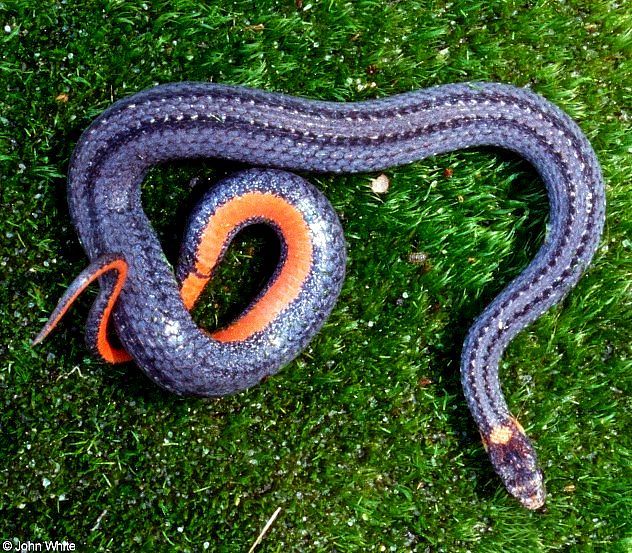
Northern Redbelly Snake
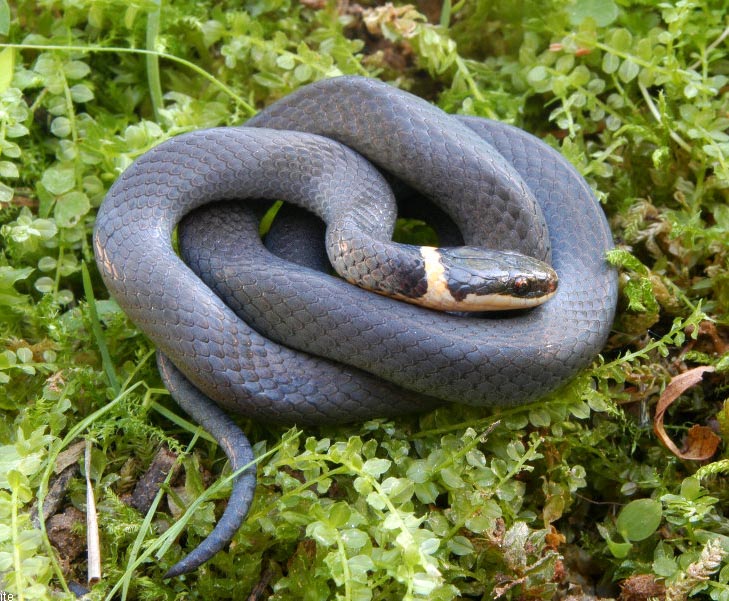
Northern Ringneck
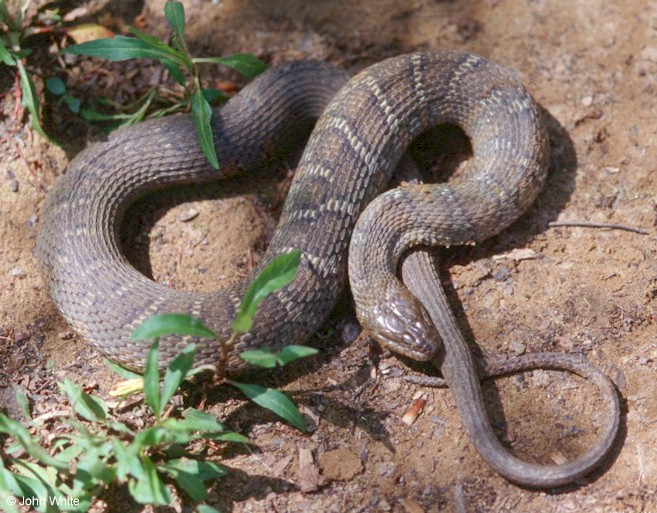
Northern Water Snake
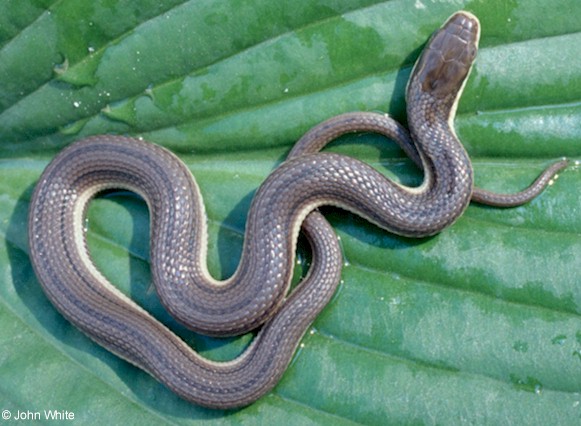
Queen Snake
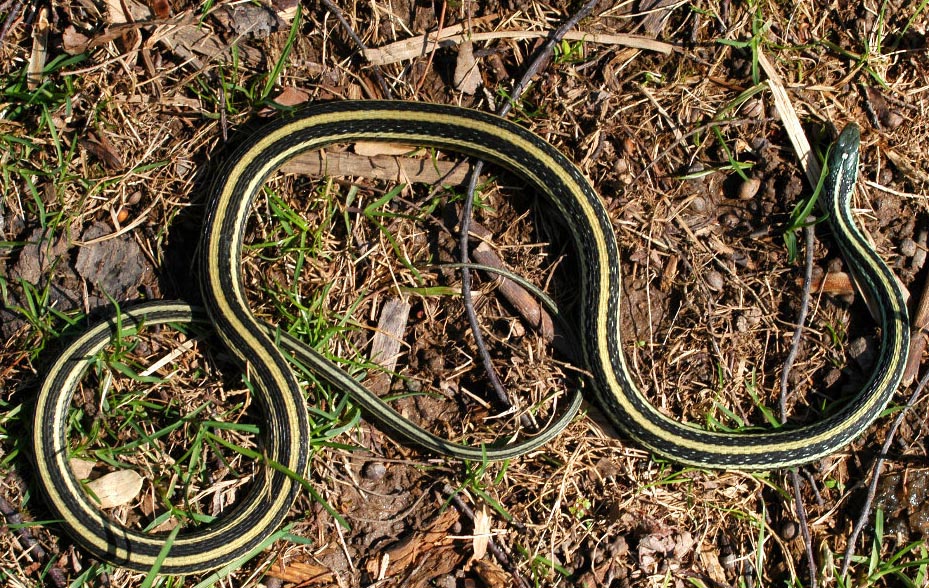
Ribbon Snake
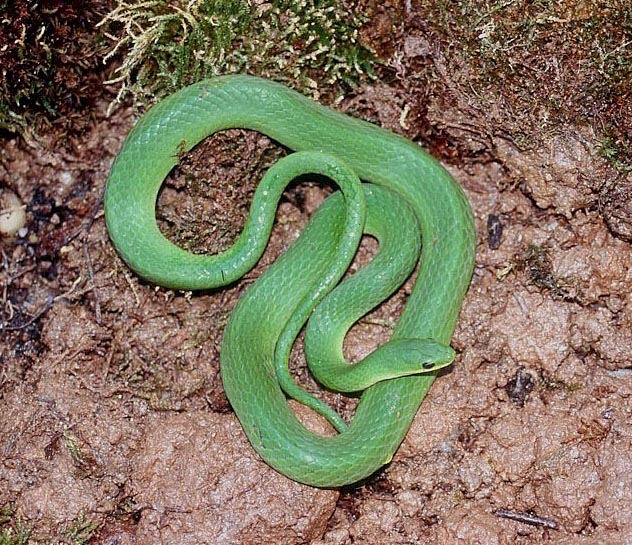
Smooth Green Snake
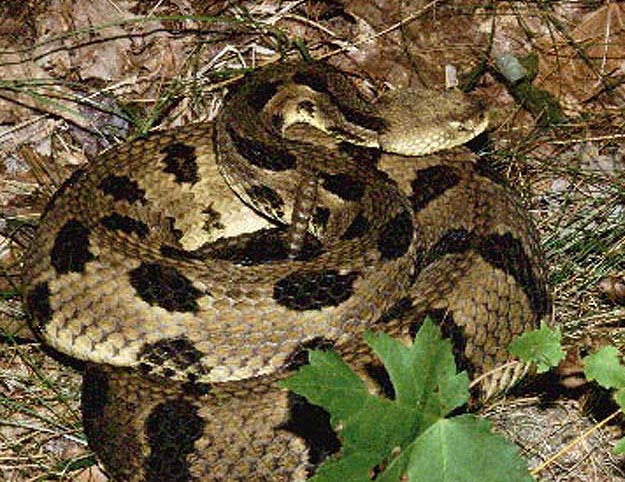
Timber Rattlesnake
No pictures available for:
Maritime garter snake (a subspecies of 'common garter snake')Shorthead garter snake (University of Pittsburgh photo HERE)For more information, visit the Cortland Herpetology Connection.
Recommended ReadingFor Identification and Snakebite Treatment:
Conant, Roger, and Joseph T. Collins. 1991. A field guide to reptiles and amphibians: eastern and central North America. Houghton Mifflin Co., Boston, MA. 450 pages
For Natural History:
Tyning, Thomas F. 1990. A guide to amphibians and reptiles: a Stokes nature guide. Little, Brown and Co., Boston, MA. 400 pages
Credits:
Prepared by Glenn Johnson, Department of Environmental and Forest Biology, SUNY-ESF. Updated with the assistance of James P. Gibbs, Professor, Department of Environmental and Forest Biology, SUNY-ESF. Photos courtesy of the Museum of Natural History for the Province of Nova Scotia and the University of California.


Comments
Post a Comment